62 hand-assembled Fox-body Mustangs. Carroll Shelby's personal blessing. The blueprint for the 1993 SVT Cobra. Almost no one has heard of them.
By 1991, Carroll Shelby had been absent from the Mustang world for over two decades. He was under contract to his old friend Lee Iacocca at Chrysler, lending his name to performance Dodges while the Fox-body Mustang — capable, popular, but unblessed — soldiered on without him.
Into this void stepped three members of the Shelby American Automobile Club: Rick Kopec, a senior SAAC officer; Ken Eber, the club's national director; and David Wagner, who ran Ford's Power Products Operations Group — the internal department that would become SVT. Wagner had previously supplied 302 engines to Brian Angliss for AC MK Is and helped Steve Saleen certify the SSC. He was, by any measure, the right man in the right room.
They formed the SAAC Car Company, based at 12650 Universal Drive, Taylor, Michigan — a facility operated by Watson Engineering, who would hand-build every car. Their performance targets were unambiguous: 0–60 in under six seconds, quarter mile under 14 seconds, top speed over 150 mph. Braking and handling to match. It had to be an honest performance car, not a cosmetic package.
Carroll Shelby drove prototype XX1 in Detroit and issued his famous challenge:
Building one car doesn't mean you're a manufacturer. Hell, anybody can build one car. You won't be a manufacturer until you've built 50 cars.
— Carroll Shelby, on driving SAAC Prototype XX1They built 62.
Every other Fox-body tuner of the era — Saleen, Steeda, Kenny Brown — was blocked from creating a complete engine package by the cost of federal emissions certification. A 50,000-mile EPA cycle was pocket change for Ford, insurmountable for a small company.
Wagner solved it. He discovered that SVO could sell GT40 components individually but had never certified a complete engine package, because they had no production vehicle to certify it in. His proposal: SAAC would provide the car, Ford SVO would share the testing cost. When the car passed — and correctly built, it would — two things happened simultaneously: SVO received their first federally certified GT40 crate engine package. And the SAAC Car Company became a legal manufacturer in all 50 states.
Ford saved money and gained a product. SAAC gained their certification. The GT40 package that would eventually power the 1993 SVT Cobra got its federal approval on an SAAC Mustang first.
The first three cars unveiled at SAAC's 16th annual convention at Charlotte Motor Speedway, June 1991, wore handmade oval badges that said "Shelby." When the photographs reached Motor Trend — with the Shelby badge prominently visible on the cover — Chrysler's legal department reacted immediately.
Shelby personally interceded before any formal action was taken. His contract with Chrysler forbade his name on any non-Chrysler product. The first nine production cars carried "Shelby AAC MK I" badges — then those too had to be replaced. The final logo: a stylized Cobra snake forming the "S," with "AAC" in matching letters. Some early buyers, who had ordered specifically because of the Shelby name, cancelled.
They were wrong to. Every road test of the SAAC was a glowing report. Every owner was at a loss to say anything bad about the car. The name didn't save it or doom it. The car stood on its own.
In 1993, Ford's SVT division launched the Mustang Cobra using — almost precisely — the SAAC's parts list: GT40 heads, GT40 intake, 65mm throttle body, four-wheel disc brakes, 17-inch wheels. Built on the production line. With a manufacturer's warranty. At a fraction of the SAAC's price. One owner put it succinctly:
The '93 Cobra is where all our parts went. That's what killed the SAAC cars.
— SAAC owner, quoted in Hemmings Muscle Machines, November 2013The all-new 1994 Mustang platform would have required entirely new tooling. The SAAC Car Company quietly folded. 62 cars. That was all there would ever be.
The following figures are drawn from the SAAC Car Company's own "Running Production Changes" document — the official production ledger. These are the authoritative numbers.
| Designation | Qty |
|---|---|
| SAAC MK I — Prototypes (XX series) | 4 |
| SAAC MK I — Certification Car (CX) | 1 |
| SAAC MK I — Hatchback (production) | 30 |
| SAAC MK I — Drag Car (XD) | 1 |
| SAAC MK I — R-Model (planned; never built) | 0 |
| SAAC MK II — Prototype Convertible | 1 |
| SAAC MK II — Hatchback (production) | 3 |
| SAAC MK II — Convertible (production) | 11 |
| SAAC Snake — Hatchback | 8 |
| SAAC Snake — Convertible | 3 |
| TOTAL SAAC PRODUCTION | 62 |
Note: The R-Model was planned but never built. Zero examples exist. Automatic transmission was available on Snake models only — none were ever ordered.
The SAAC Mustang is rarer than any factory Shelby Mustang ever sold to the public. Rarer than the 1993 Cobra R. The only Carroll Shelby–endorsed Fox-body Mustang ever built for the street.
| Cars 1–9 | "Shelby AAC MK I" oval badges on nose, deck lid, quarter windows, steering wheel |
| Car 10+ | Cobra-S / "AAC" logo replaces Shelby badges; no retrofit of earlier cars |
| Cars 1–9 | Ford Motorsport progressive-rate springs |
| Car 10+ | Eibach variable-rate lowering springs (1¼" front, 1" rear drop) |
| First few cars | Hand-cut 3M stripes (slightly thinner from rear wheel back) |
| Later cars | Die-cut 3M tape, uniform width |
| Early MK I | B303 cam with 1.6 roller rockers included |
| Valve covers | Cars 1–9: "Shelby" lettered; Car 10+: SAAC Cobra-S logo |
No other private collection holds this concentration of SAAC history: three production cars spanning the MK I and MK II designation, plus the only known post-production tribute car built from genuine SAAC Parts after the SAAC Car Company ceased operations. Together they represent approximately 6% of all SAAC production.
SAAC MK II #018 is the most uniquely specified car in the entire 62-vehicle SAAC production run — and simultaneously one of the most historically significant vehicles ever to pass through the hands of the car community around Paul Walker and Roger Rodas.
It was purchased on January 14, 2011 by Roger Rodas of Always Evolving (AE) Performance — the Valencia, California workshop and car business co-founded with actor and genuine car enthusiast Paul Walker. Rodas was a professional racing driver. His judgement on cars was professional, not aspirational. The fact that this car was selected for the AE Performance collection is itself a statement about its quality.
The car was listed on the AE Performance website for $35,000 on August 24, 2013. Three months later, on November 30, 2013, Roger Rodas and Paul Walker were both killed in a Porsche Carrera GT crash in Santa Clarita, California. Rodas was driving.
In the years that followed, the car passed through multiple owners who did not know its history. It sold as low as $15,000. The highest bid it ever received at auction was $20,700. Meanwhile, the Porsche Carrera GT from the same AE Performance collection sold for $1.32 million in 2015.
The Cameron Collection now holds this car — and its complete, documented ownership history. The car that no one knew what it was has found an owner who does.
SAAC Grid Code: 3RWSWBSPN
VIN: 1FACP45E6PF120158 · Built 11/27/1992 at Watson Engineering, Taylor MI · Ford build date: October 16, 1992 (Dearborn) · Boston DSO 11
Completed as SAAC MK II #018. Vermillion Red / white top / white Recaro interior. SAAC grid code 3RWSWBSPN.
16 miles on odometer at delivery. Boston District Sales Office (DSO 11).
Purchased from Rizzo Ford. First private owner.
Odometer: 32,000 miles. Minor surface cracks in convertible top; dime-sized dent on right front fender noted.
Purchased for $30,000. Rodas was a professional racing driver and co-founder of Always Evolving (AE) Performance with Paul Walker. The car enters the AE Performance collection.
Car brought to Richmond for mechanical issues.
Active listing on the AE Performance business site. Rodas's asking price reflects modest appreciation on his $30,000 purchase.
The Porsche Carrera GT crash. Both men died. The AE Performance collection begins to be dispersed. The car's provenance becomes historically fixed.
BIN $29,995 / High bid $18,800. No sale.
Provenance unknown to market.
Car professionally cleaned. Hood and trunk stripes replaced. Side splats repositioned flush with body side moldings. Chrome CS wheels fitted; stock Simmons wheels transferred to MK I #007.
Sold along with MK I #007, MK II #001, and MK II #011 — four SAAC cars in one transaction.
High bid $19,500. Reserve not met.
Four separate attempts to sell. High bid at auction: $20,700. Reserve repeatedly not met. Correct market never reached.
Last documented sale before Cameron Collection acquisition. Provenance still unknown to market at time of sale.
Full provenance documented and authenticated for the first time. The car and its history are now properly recorded.
The SAAC was not a visual package. Every modification served a purpose. The result was federally certified in all 50 states, available with manufacturer financing, and capable of embarrassing cars that cost significantly more.
| Engine | 5.0-liter (302 cu in) Windsor pushrod V8 |
| Cylinder heads | Ford Motorsport GT40 cast-iron — first production vehicle use |
| Intake manifold | GT40 aluminum upper and lower, 1.65" runners |
| Throttle body | 65mm (stock: 58mm) |
| Cam (early cars) | B303 with 1.6 roller rockers |
| Headers | Ceramic-coated 1-5/8" shorty |
| Exhaust | 2.5" mandrel-bent dual, Borla mufflers |
| Pulleys | Underdrive set — 14% RPM reduction |
| Compression | 9.2:1 (up from 9.0:1) |
| Valve covers | SAAC-specific finned aluminium (SAAC Cobra logo) |
| Output | 295 bhp @ 5,250 rpm / 334 lb-ft @ 3,750 rpm |
| Transmission | T-5 5-speed, Hurst short-throw shifter |
| Final drive (MK I/II) | 3.27:1 Traction-Lok (factory auto-only ratio — specially sourced) |
| Clutch | Centerforce Dual-Friction heavy-duty |
| Fuel economy | 17 city / 24 highway mpg (EPA, confirmed on #040 Monroney) |
| Springs | Eibach variable-rate lowering (car 10+) |
| Dampers | Koni adjustable gas (all four) |
| Strut brace | SVO design, within engine bay confines |
| Roll bar | 4-point — listed as "Interior Chassis Stiffening Brace" (legal requirement) |
| Front brakes | 11-inch vented discs, 5-lug |
| Rear brakes | 11-inch discs (converted from drums), 5-lug |
| Brake ducts | In front valence (fog lamp positions removed) |
| Wheels | 17 × 7.5" front / 17 × 8" rear Simmons 5-spoke split-rim (Australia) |
| Tires | Goodyear 245/45ZR17 Gatorback directional |
| Curb weight | Approx. 3,195 lbs |
| 0–60 mph | 5.2 sec (Automobile Magazine, prototype XX2, Nov 1991) |
| 0–60 mph | 5.3 sec (Car and Driver, December 1991) |
| ¼ mile | 13.7 sec @ 104 mph (Automobile Magazine, Nov 1991) |
| ¼ mile | Under 13.6 sec (Car and Driver) |
| Top speed | 135 mph (Automobile Magazine test) |
| vs. stock GT | +70 bhp / approx. 1 second faster in ¼ mile |
It turns into corners quickly, rolls over and understeers, and then on the way out of the corner the rear end sits down and squats. There was power to spare and yet not so much torque that you would inadvertently spin the rear tires. The result is a wonderfully useful car for driving fast on public roads.
— Michael Jordan, Automobile Magazine, November 1991 (Prototype XX2)
The SAAC Mustang has been covered by every major American automotive publication — from its debut in 1991 to retrospective evaluations three decades later. The verdict has been consistent.
Fans and defenders of the SAAC cars look at their truncated production, and the speed with which SVT brought out the Fox-body 1993 Cobra models — which similarly included an aluminum intake based on the GT40, the GT40 iron heads, four-wheel-disc brakes, revised lower body cladding, 17-inch wheels and tires, and a boosted power rating — and say, aha! Ford built the SVT Cobra on the backs of the SAAC folks' experience.
— Jeff Koch, Hemmings Muscle Machines, November 2013Additional coverage confirmed:
Car and Driver · December 1991 — Road test of SAAC MK I. 0–60: 5.3 seconds. Quarter mile: under 13.6 seconds.
Motor Trend · 1991 — Cover photograph of prototype with original Shelby nose badge. The image that triggered Chrysler's legal response.
Mustang Monthly · 2001 — "Black Mamba" feature on SAAC Snake #008.
Shelby American World Registry, 1997 Edition — Eleven-page section on 1991–93 SAAC Mustangs, authored by Richard Plescia. The definitive registry inclusion.
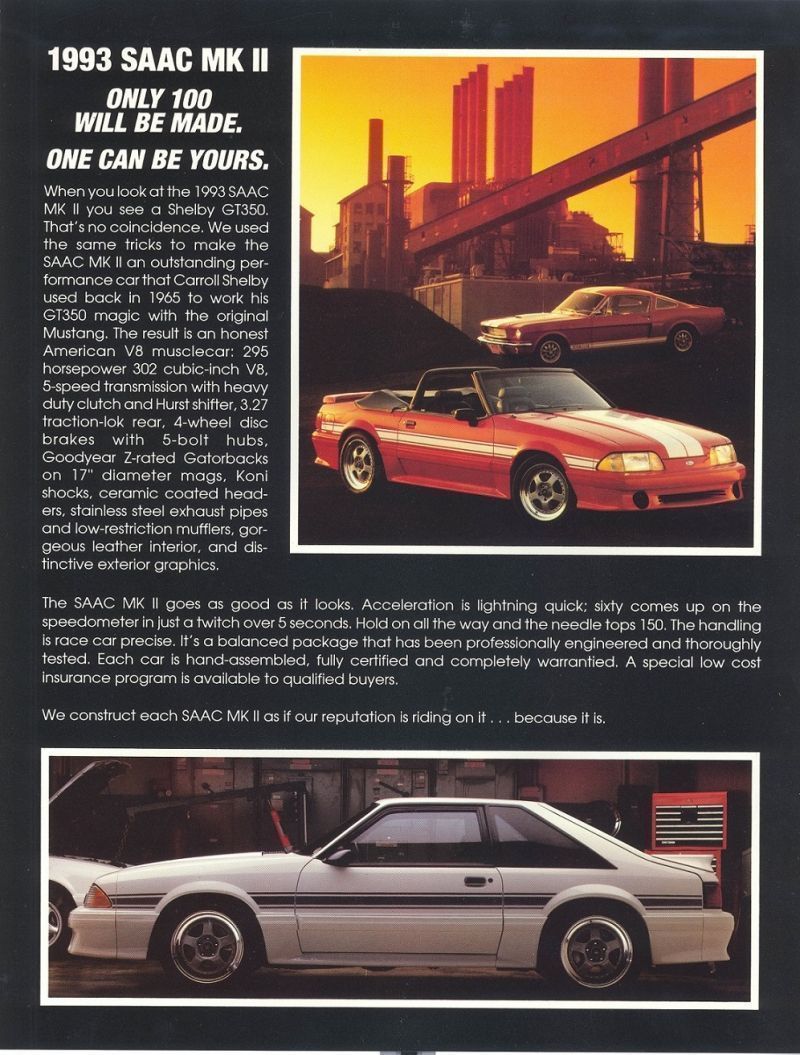
Factory brochures, dealer pricing sheets, and promotional materials from SAAC Car Company — the original voices pitching the future of American performance. Authentic period documentation of the cars as they were offered to the world.
Context — The Sales Pitch:
These documents represent SAAC Car Company's pitch to the market: a hand-assembled alternative to factory performance cars, built with direct inspiration from Carroll Shelby's original GT350 philosophy. Dealers positioned the SAAC as a complete car — not a modification kit — with full factory warranty support and exclusive buyer programs. The brochures emphasize exclusivity (limited production), authenticity (Carroll Shelby's personal involvement), and performance (specifications that exceeded the 1993 Cobra in power density). Each variant — MK I, MK II, and Snake — was marketed to a specific buyer profile, from the hatchback purist to the convertible enthusiast to the track-focused driver.
With only 62 vehicles produced, every surviving SAAC Mustang is significant. If you own, have owned, or have information about a SAAC MK I, MK II, or Snake, we want to hear from you. The goal is the most complete registry possible.
| MK I #007 | Wimbledon White. Built Oct 9, 1991. One of first 9 with Shelby badges. 10,600 miles at 2003 Mustang Monthly feature. |
| MK II #012 | Wimbledon White hatchback. Cameron Collection. One of only 3 MK II hatchbacks. |
| MK I #013 | 203 miles. Bring a Trailer auction, March 2025. Bid ~$80,000+. |
| MK II #018 | Red/white convertible. Ex-Roger Rodas, AE Performance. Cameron Collection. |
| MK I #040 | Wimbledon White. Original Swilley papers. Cameron Collection. |
| MK II #001 | Black/gold convertible. Last car produced. Owner: Scott Warren. |
| MK II #006 | Unmodified. 50 miles. Ames Automotive Foundation, NY. |
| Snake #002 | Black/gold, Vortech supercharged. Scott Warren. |
| Snake #008 | "Black Mamba" — Mustang Monthly 2001. |
| MK II #022 Tribute | Vermilion Red convertible. VIN 1FACP45EXMF190290. Andrew Enot tribute/conversion (Michigan, 2003–04). 427 hp supercharged. Purchased by Richard Cameron 11/19/2019 from Daniel Triplett (Wichita KS). 24,773 miles. |
This list is incomplete. If you have information on any additional survivors, please use the contact form.
| Highest sale | $122,500 — 1992 SAAC MK I (May 2023) |
| Average (Classic.com) | $97,800 |
| MK I #013 (203 mi), 2025 | ~$80,000+ bid |
| 1991 Prototype, 2023 | $61,000 |
The SAAC Registry is the definitive record of surviving SAAC Mustangs. It supplements the official SAAC.com forum (Board 41) and the 1997 Shelby American World Registry. Registry expert: Richard Plescia. For official SAAC club resources: saac.com
Every car. Every VIN. Every grid code. Every owner. Interactive decoders, searchable registry table, individual car histories, full specification data, and the complete SAACPARTS catalogue — all from the official Shelby World Registry, reproduced for the first time in searchable digital form.